Sleep
Best Sunrise Alarm Clocks UK (2026): Do Wake-Up Lights Work?
Quick answer
A sunrise alarm clock slowly brightens before your alarm, which small studies link to feeling more alert on waking. For most UK readers the Lumie Bodyclock Glow 150 (£119) balances adjustable sunrise length, sounds and price. The Lumie Sunrise Alarm (£49.98) is a cheap trial. None replaces a SAD light box or medical advice.
Our picks


Lumie Bodyclock Glow 150
Lumie
- • 20, 30 or 45-minute sunrise
- • 10 sleep and wake sounds
Honest caveat: Benefits for mood and alertness come from small studies; a bright morning walk is free and has a similar rationale. Brightness is lower than a SAD light box.
lumie.com


Lumie Sunrise Alarm
Lumie
- • 30-minute sunrise and sunset
- • 10 white light levels plus mood colours
Honest caveat: Fixed 30-minute sunrise only. It is a lifestyle alarm, not a light-therapy device for SAD (seasonal affective disorder), and dawn simulation trials are small.
lumie.com


Lumie Bodyclock Luxe 750DAB
Lumie
- • 15 to 90-minute sunrise and sunset
- • 30+ sleep and wake sounds
Honest caveat: £229 is a lot for features you may not use. Longer sunrises are not proven to work better than 30 minutes.
lumie.com


Lumie Bodyclock Rise 100
Lumie
- • 30-minute sunrise and sunset
- • Adjustable sunrise brightness
Honest caveat: Sunrise length is fixed at 30 minutes and there are no wake sounds beyond a beep, which is thin for £99.
lumie.com


Lumie Bodyclock Shine 300
Lumie
- • Sunrise and sunset simulation
- • Much dimmer than a SAD lamp
Honest caveat: A wake-up light is far dimmer than a SAD lamp and the trials behind dawn simulation are small. Think of it as an add-on to, not a swap for, bright light therapy.
Lumie
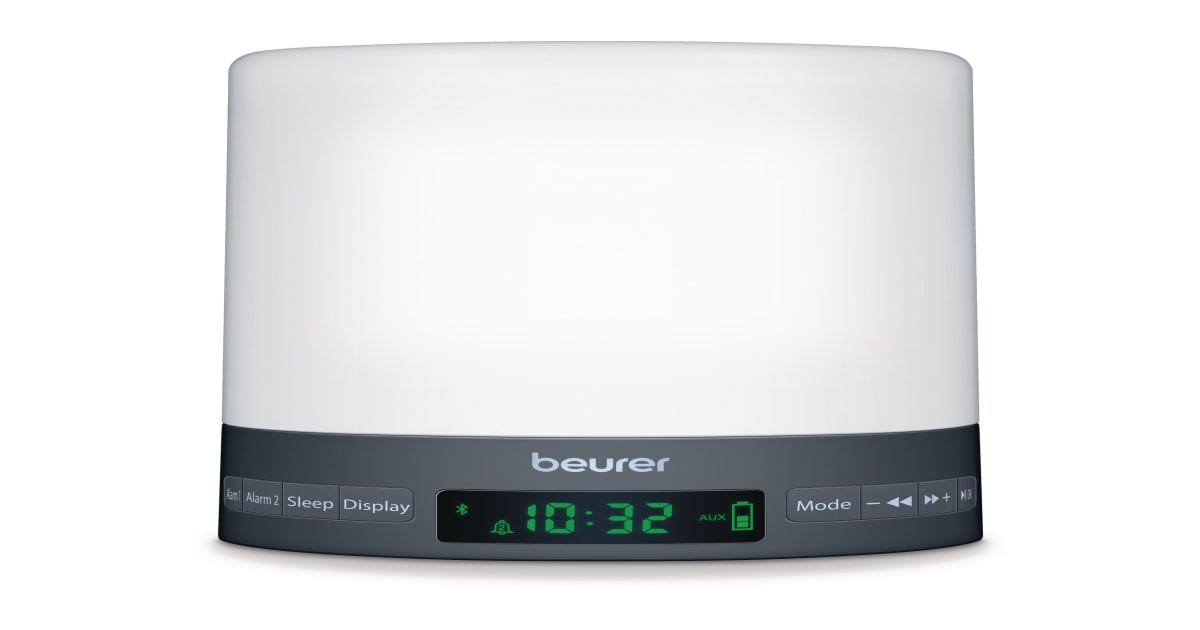
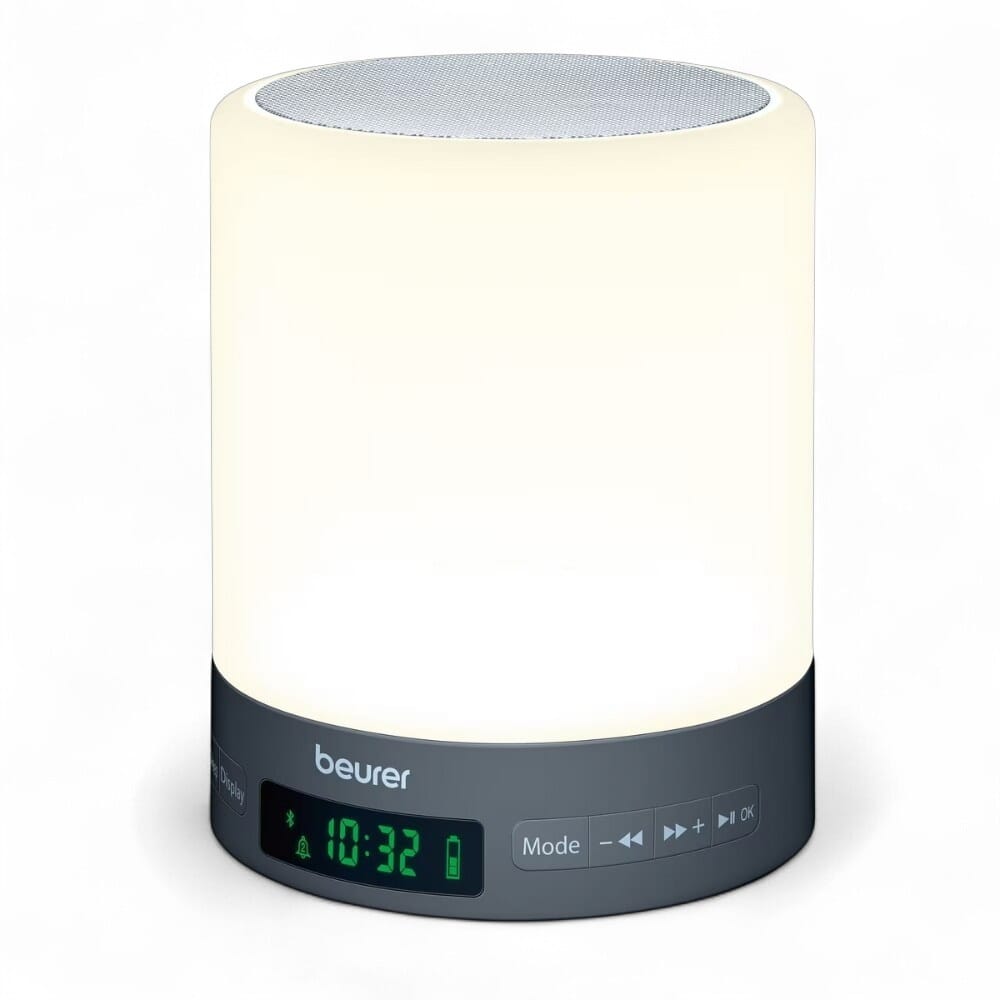
Beurer WL 50 Wake-up Light
Beurer
- • 330 lux at 15 cm (brand figure)
- • Radio, Bluetooth and AUX
Honest caveat: We verified £79.90 at Essential Aids, whose page showed mixed stock messages (in stock and pre-order). Beurer’s own UK page did not list a price.
essentialaids.com


Hatch Restore 3
Hatch
- • Sunrise alarm plus sleep sounds
- • Phone-free controls, app setup
Honest caveat: Healf’s page says it comes with a US plug and needs 2.4GHz Wi-Fi; some content sits behind an optional paid subscription. Brightness is modest compared with Lumie’s larger lamps.
healf.com
We may earn a commission if you buy through our links. How we choose ›
How strong is the research? What our grades mean ›
- Strong research
- Independent certification or lab data for the specific claim.
- Promising research
- The material is well supported, but there is no product-level testing.
- Early research
- Little independent research.
- Mixed research
- Research findings disagree.
- £
- Under £20
- ££
- £20 to £79
- £££
- £80+
Our picks at a glance
| Product | Best for | Material/key feature | Price | Evidence grade |
|---|---|---|---|---|
| Lumie Bodyclock Glow 150 | Best overall | 20, 30 or 45-min sunrise, 10 sounds | £119 | Early |
| Lumie Sunrise Alarm | Budget pick | Fixed 30-min sunrise, 6 sounds | £49.98 | Early |
| Lumie Bodyclock Rise 100 | Simple light-only | 30-min sunrise, adjustable brightness | £99 | Early |
| Lumie Bodyclock Shine 300 | Brighter light, more options | Larger lamp, radio, sounds | £149 | Early |
| Lumie Bodyclock Luxe 750DAB | Premium all-in-one | 15 to 90-min sunrise, DAB, Bluetooth | £229 | Early |
| Beurer WL 50 Wake-up Light | Non-Lumie option | 330 lux at 15 cm, radio, Bluetooth | £79.90 | Early |
| Hatch Restore 3 | Phone-free routine | Sunrise plus sleep sounds, app setup | £149.99 | Early |
We use four site labels: Strong, Promising, Early and Mixed research. Early means a few small studies, often short and in specific groups.
What does a sunrise alarm claim to do?
The idea is to copy a summer dawn indoors. Over 15 to 90 minutes the lamp brightens from a dim red to a brighter white, so your eyes (which pick up light even through closed eyelids) receive a "morning" signal before you wake. Brands say this helps you wake more naturally, feel less groggy, and cope better with dark winter mornings.
What the evidence shows
| Claim | Evidence grade | Best evidence |
|---|---|---|
| Feel more alert and perform better just after waking | Early | Thompson et al., 2014: light in the last 30 minutes of sleep improved alertness and performance in a small lab study |
| Better self-rated sleep quality | Early | Community trial, BMC Psychiatry 2003: "benefits are modest" |
| Help with winter depression (SAD) | Promising | Golden et al. meta-analysis, 2005: five dawn simulation studies, moderate effect; Terman 2010 on body-clock shift |
| Replaces a light box for SAD | Mixed | No head-to-head evidence strong enough; brightness of bedside lamps is much lower |
The best summary is that dawn simulation is a gentle, low-risk way to make waking easier, with small studies behind it. The 2005 meta-analysis in the American Journal of Psychiatry found dawn simulation reduced symptoms of seasonal depression, but it pooled just five small studies, and the authors noted many light therapy studies were not rigorous. The NHS page on SAD treatment says there is not enough evidence to tell whether light therapy is effective, though many people find it helps, and advises speaking to a GP first.
Who might reasonably try one?
- People who wake before sunrise for much of the year, especially from October to March.
- Heavy sleepers who hate a sudden alarm and want a gentler start.
- Shift workers who need to wake in the dark (though shift-work sleep needs wider planning).
- Anyone who wants to keep their phone out of the bedroom, as several models include sounds and radio.
Who should be careful?
- Low mood that lasts. If you think you have SAD or depression, see your GP. A wake-up light is not a treatment.
- Eye conditions or light-sensitising medicines. The NHS notes light therapy may not suit people with certain eye conditions or taking medicines that increase light sensitivity.
- Bipolar disorder. Bright light can affect mood in both directions; get medical advice first.
How we chose
We looked for: adjustable sunrise length and brightness; a sunset or fade-down mode for winding down; a backup sound; clear UK pricing on a live page; and no misleading health claims. All prices were checked in October 2026.
Lumie Bodyclock Glow 150: best overall
The Glow 150 (£119) lets you choose a 20, 30 or 45-minute sunrise and sunset, adjust the sunrise brightness, and pick from 10 sleep and wake sounds. That covers what most people need without paying for radio. Caveat: brightness is far below a 10,000 lux light box, so do not expect SAD-level light therapy.
Lumie Sunrise Alarm: budget pick
The Lumie Sunrise Alarm (£49.98) gives a fixed 30-minute sunrise and sunset, 10 white light levels, colour mood lighting and six wake sounds. It is the cheapest way to find out whether you like waking to light. Caveat: no adjustable sunrise length, and the light is modest.
Lumie Bodyclock Rise 100: simple and quiet
The Rise 100 (£99) is a light-first clock with adjustable sunrise intensity, an optional beep and a fade-to-nightlight option. It suits people who do not want sounds at all. Caveat: fixed 30-minute sunrise, and you pay £99 for few extras.
Lumie Bodyclock Shine 300: brighter mid-premium option
Already in our SAD lamp and light guide, the Bodyclock Shine 300 (£149) adds more sounds, radio and a larger lamp. Consider it if you want more light and more options than the Glow 150.
Lumie Bodyclock Luxe 750DAB: premium all-in-one
The Luxe 750DAB (£229) has the widest sunrise range we found (15 to 90 minutes), 30+ sleep and wake sounds, DAB radio and a Bluetooth speaker. It can also double as a bedside white noise source. Caveat: most of the extra cost is audio, and there is no evidence a 90-minute sunrise works better than 30.
Beurer WL 50: the non-Lumie choice
Beurer is a German health-device maker. Its WL 50 lists 330 lux at 15 cm, two alarm times, radio, Bluetooth and AUX, and can run on battery or USB. We verified £79.90 at Essential Aids. Caveat: that page showed mixed stock messages, and Beurer's UK page did not list a price.
Hatch Restore 3: phone-free routine
The Hatch Restore 3 combines a sunrise alarm with sleep sounds and wind-down content, aiming to replace your phone at bedtime. UK wellness retailer Healf lists it at £149.99. Caveat: the listing says it comes with a US plug and needs 2.4GHz Wi-Fi, and some content is behind an optional subscription.
What about Philips wake-up lights?
Philips made some of the best-known wake-up lights, but when we checked philips.co.uk in October 2026 the models we looked at (including the HF3505 at £99.99, and the HF3520 and HF3531) were listed as out of stock or discontinued. We have left them out until they are reliably available in the UK.
If you want to try one: what to look for
- Adjustable sunrise length (20 to 45 minutes is plenty for most).
- Sunset mode to dim the room gradually at bedtime, avoiding bright overhead lights late at night.
- A backup sound you trust to wake you.
- A dimmable or auto-dimming display, so the clock face does not light the room all night.
- UK plug and warranty from a UK seller.
Pair it with daylight: a 20-minute walk outside in the morning gives far more light than any bedside lamp, and the NHS suggests getting outside in daylight every day to help with winter low mood.
Bottom line
A sunrise alarm is a pleasant, low-risk way to make dark mornings easier, with Early evidence for waking and Promising but small evidence for winter low mood. The Lumie Glow 150 is the best balance for most people; the £49.98 Lumie Sunrise Alarm is a sensible trial. If you think you have SAD, speak to your GP and look at proper light therapy rather than relying on a clock.
Frequently asked questions
Do sunrise alarm clocks actually work?
+
Small studies suggest they help. A 2014 lab study found light in the last 30 minutes of sleep improved alertness and performance after waking, and a 2003 community trial found modest improvements in self-rated sleep. Evidence is Early: studies are small and short. Many people simply find waking to light more pleasant than a buzzer.
Can a sunrise alarm clock help with SAD?
+
A 2005 meta-analysis found dawn simulation reduced seasonal depression symptoms, but it pooled only five small studies. The NHS says there is not enough evidence to tell whether light therapy works, though many find it helps, and advises speaking to a GP first. A bedside wake-up light is much dimmer than a light box.
How long should the sunrise be on a wake-up light?
+
Most studies used about 30 minutes, and 20 to 45 minutes suits most people. Longer sunrises of 60 to 90 minutes are available on premium models but there is no good evidence they work better. If you are a light sleeper, a shorter sunrise may stop you waking too early.
Is the Lumie Sunrise Alarm worth it?
+
At £49.98 it is a sensible first try: 30-minute sunrise and sunset, 10 light levels and six sounds from a UK brand. Its limits are a fixed sunrise length and modest brightness. If you know you like waking to light, the Bodyclock Glow 150 adds adjustable timing and more sounds for £119.
Can I use a Hatch Restore 3 in the UK?
+
Yes, it is sold by UK retailer Healf at £149.99, but the listing says it comes with a US plug and needs a 2.4GHz Wi-Fi connection and app setup. Check whether a UK adapter is included or buy a properly rated one, and note that some sleep content needs an optional subscription.
Are sunrise alarm clocks good for children?
+
Some families use them to teach children when it is time to get up, often with a colour-change 'ok to wake' light. Keep the brightness low at night, place cables out of reach, and avoid bright blue-white light in the evening. Any device by a cot should follow Lullaby Trust advice to keep the sleep space clear.
Last updated