Cleaning
Best Non-Toxic Cleaning Products UK (2026): Fragrance-Free Picks That Work
Quick answer
The best lower-exposure cleaning products are fragrance-free, non-aerosol and used without routine disinfectants. Our top pick is Koh Universal Cleaner (Allergy UK Seal, two ingredients), with Bio-D Fragrance Free Toilet Cleaner and Miniml fragrance-free vinegar as budget options. Ventilate while cleaning and never mix bleach with acids or ammonia.
Our picks


Koh Universal Cleaner 2L
Koh
- • Allergy UK Seal of Approval
- • Fragrance-free, two listed ingredients
Honest caveat: It works because it is alkaline, so it can dry or irritate skin; wear gloves for long sessions and patch test delicate finishes. Koh does not publish the pH on its UK product page, and the Allergy UK seal is about allergy risk, not disinfection.
Koh


Nonscents Organic Multi-Surface Spray
Greenscents
- • Nonscents option has no added fragrance or essential oils
- • Soil Association certified organic
Honest caveat: Organic certification checks how ingredients are sourced, not indoor air emissions or cleaning performance. It is preserved with benzyl alcohol and dehydroacetic acid, and the 500ml bottle costs several times more than supermarket sprays.
Greenscents
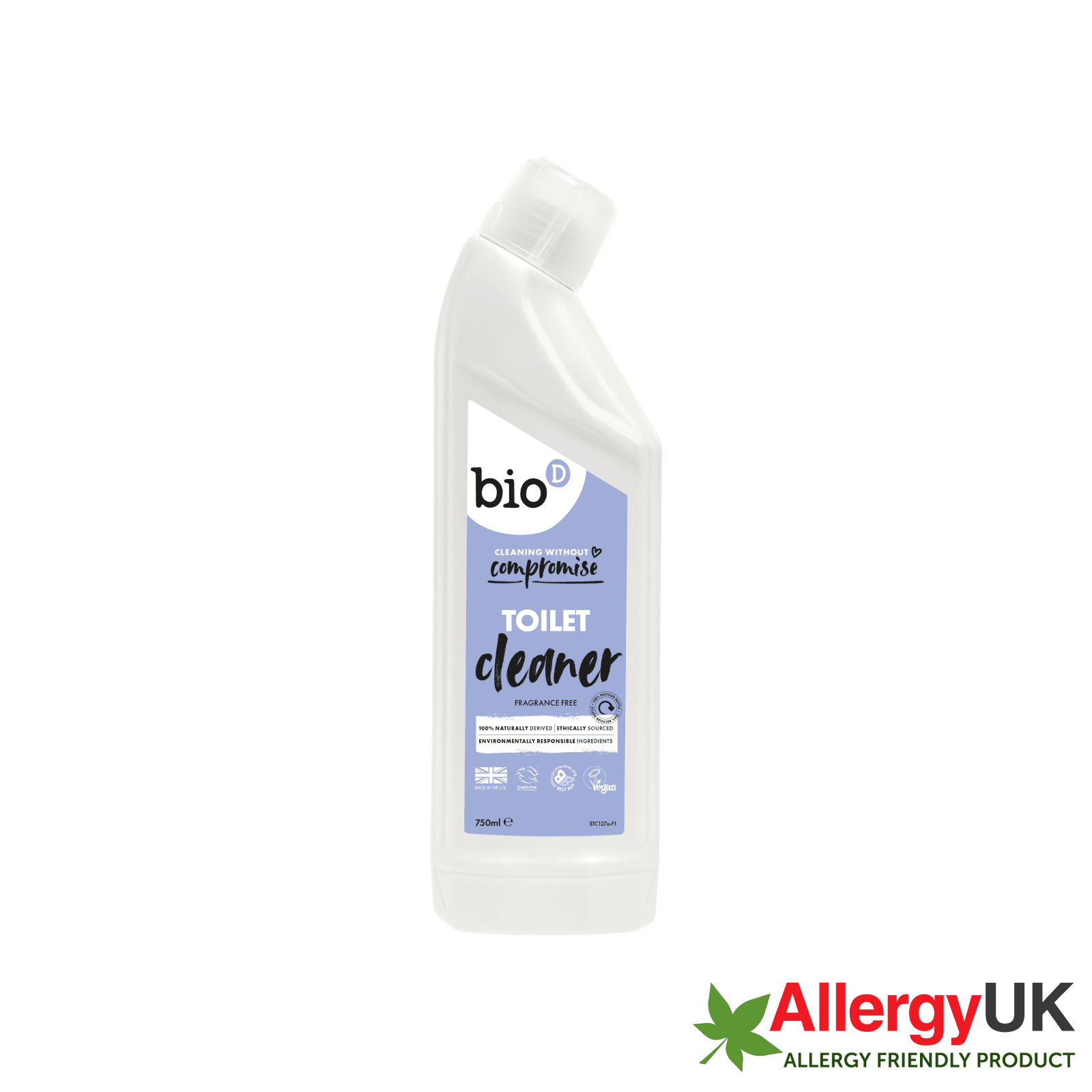

Bio-D Fragrance Free Toilet Cleaner 750ml
Bio-D
- • Allergy UK accredited
- • Fragrance-free
Honest caveat: It is acidic (pH 3), so do not combine it with bleach-based products. It showed as out of stock on Bio-D’s own shop when we checked, although it is widely sold by eco retailers.
Bio-D


Nonscents Organic Loo Cleaner
Greenscents
- • No bleach
- • Nonscents variant has no essential oils
Honest caveat: The page makes an ’anti-bacterial’ claim but does not cite a standard test (such as BS EN 1276), so treat it as a cleaner rather than a disinfectant. It also contains neem oil, which has its own smell.
Greenscents


Greenscents Organic Glass Cleaner (Nonscents)
Greenscents
- • Fragrance-free only
- • Ammonia-free, vinegar based
Honest caveat: At £7.50 for 500ml it is mostly water and vinegar, so it is a convenience buy. Soil Association certification covers ingredient sourcing, not streak performance or emissions.
Greenscents


White Vinegar - Pure Fragrance Free
Miniml
- • Only water and 5% acetic acid
- • Fragrance-free
Honest caveat: Vinegar is a descaler and degreaser, not a registered disinfectant. Never mix it with bleach: UKHSA warns that bleach plus acidic products releases chlorine gas. Not food grade.
Miniml
We may earn a commission if you buy through our links. How we choose ›
How strong is the research? What our grades mean ›
- Strong research
- Independent certification or lab data for the specific claim.
- Promising research
- The material is well supported, but there is no product-level testing.
- Early research
- Little independent research.
- Mixed research
- Research findings disagree.
- £
- Under £20
- ££
- £20 to £79
- £££
- £80+
What makes a cleaning product "lower exposure"?
There is no legal definition of "non toxic" for cleaning products in the UK, so the label tells you very little. What the evidence does support is cutting four specific exposures: added fragrance (a common skin allergen and a major source of indoor VOCs, or volatile organic compounds, the gases that evaporate from products), spray mists that you breathe in, harsh disinfectants such as bleach and quats used where plain cleaning would do, and accidental mixing of incompatible products.
The strongest single study is a 20-year European cohort of 6,235 adults published in 2018. Women who cleaned at home lost lung function faster (22.1 ml a year) than women who did not clean (18.5 ml a year), and cleaning sprays and other cleaning agents were both associated with faster decline (Svanes et al., 2018). It is observational, so it shows a link rather than proof, and no significant effect was seen in men. But it is consistent with official advice: NICE tells people whose asthma is triggered by sprays to use non-spray alternatives and to ventilate when cleaning (NICE NG149).
Our picks at a glance
| Product | Best for | Material/key feature | Price | Evidence grade |
|---|---|---|---|---|
| Koh Universal Cleaner 2L | One bottle for most hard surfaces | Two ingredients, fragrance-free, Allergy UK Seal | £10.95 | Strong |
| Nonscents Organic Multi-Surface Spray | Kitchen wipe-downs | Fragrance-free, Soil Association organic | £7.95 | Moderate |
| Bio-D Fragrance Free Toilet Cleaner 750ml | Budget toilet cleaning | Allergy UK accredited, BS EN 1276 tested | £1.98 | Strong |
| Nonscents Organic Loo Cleaner | Bleach-free toilet routine | Cider vinegar base, no essential oils | £6.75 | Moderate |
| Greenscents Organic Glass Cleaner (Nonscents) | Mirrors and windows | Ammonia-free, fragrance-free only | £7.50 | Moderate |
| White Vinegar - Pure Fragrance Free | Limescale and glass on a budget | Water and 5% acetic acid | £2.50 | Moderate |
How we chose
We started with every fragrance-free surface, bathroom, toilet and glass cleaner we could find on UK brand sites and retailers, then kept products that (1) contain no added fragrance or essential oils, (2) publish a full or near-full ingredient list, and (3) are not aerosols. We gave extra weight to independent checks, such as Allergy UK accreditation or a named lab test, and graded each product on the strength of that evidence, not on marketing claims. We checked every price and page in October 2026. We do not accept payment for placement.
The best non-toxic cleaning products in the UK
Koh Universal Cleaner 2L: best overall
Koh's formula is potassium hydroxide in purified water, with no fragrance, and it holds Allergy UK's Seal of Approval. One refill covers worktops, glass, tiles and floors, which means fewer products in the cupboard and fewer exposures overall. Caveat: it works because it is alkaline, so wear gloves for longer sessions and patch test delicate finishes.
Nonscents Organic Multi-Surface Spray: best organic spray
Greenscents' Nonscents version contains no fragrance or essential oils, lists every ingredient, and is certified organic by the Soil Association. Caveat: organic certification is about how ingredients are farmed, not how the spray performs or what it releases into the air, and it costs more than supermarket sprays.
Bio-D Fragrance Free Toilet Cleaner: best budget toilet cleaner
At £2.38, this is accredited as Allergy Friendly by Allergy UK and Bio-D says it is tested to BS EN 1276, the European test for killing bacteria. Caveat: it is acidic (pH 3), so never use it in the same bowl as bleach. It showed as out of stock on Bio-D's own shop when we checked.
Nonscents Organic Loo Cleaner: best bleach-free alternative
A cider vinegar, soap nut and shikakai liquid with 98% certified organic ingredients and no essential oils in the Nonscents version. Caveat: its "anti-bacterial" claim is not backed by a named test on the page, so treat it as a cleaner, not a disinfectant.
Greenscents Organic Glass Cleaner (Nonscents): best glass cleaner
Ammonia-free, vinegar based and sold only without fragrance. Caveat: you are mostly paying for convenience, since diluted vinegar does a similar job.
White Vinegar - Pure Fragrance Free: best value
Miniml's cleaning vinegar is just water and 5% acetic acid, with a 5L refill. It handles limescale on taps and showerheads and streak-free glass. Caveat: it is not a disinfectant, it etches marble and granite, and it must never be mixed with bleach.
Why does fragrance matter so much?
Fragrance is the ingredient most worth removing. The NHS lists perfumes and preservatives among the most common causes of irritant and allergic contact dermatitis (skin reactions) (NHS). In a survey of 1,100 UK adults, 27.8% reported health problems from fragranced products, including migraines and asthma attacks (Steinemann, 2018).
UK law (retained from the EU Detergents Regulation) means a detergent label must say "perfumes" if any are added, and must name specific allergenic fragrance ingredients above 0.01% of the product. That list started as the 26 fragrance allergens identified by EU scientists, such as limonene, linalool and citronellol (Detergents Regulation, Annex VII). If you see these names, or "parfum", the product is fragranced, even if the marketing says "natural". Essential oils count too: limonene from orange oil is the same molecule as synthetic limonene.
Fragrance also affects air quality. The UK's Air Quality Expert Group notes that terpenes from fragrances, such as limonene, react with ozone indoors to form new fine particles (AQEG, 2022).
Are cleaning sprays worse than liquids?
The research points that way. Sprays create a fine mist you breathe in, and the Svanes study found accelerated lung function decline linked to sprays (Svanes et al., 2018). The US EPA notes several VOCs average 2 to 5 times higher indoors than outdoors, and lists cleansers, disinfectants and air fresheners as sources (US EPA). Practical swaps: spray onto the cloth rather than the surface, use a pump or squeeze bottle where you can, and open a window. The EU Ecolabel bans propellant aerosols in certified surface cleaners for similar reasons (EU Ecolabel criteria).
Do I need bleach or antibacterial sprays?
For most home surfaces, no. Detergent and a cloth remove most germs physically. Disinfectants are useful for specific jobs (raw meat spills, illness in the household), but routine use adds exposure. Two classes deserve care:
- Bleach (sodium hypochlorite). The UK Health Security Agency warns that mixing bleach with acidic products, such as vinegar or many toilet cleaners, releases chlorine gas, and mixing with ammonia releases chloramines, which irritate the airways (UKHSA). Never combine products in the same toilet bowl or bucket.
- Quats (quaternary ammonium compounds), found in many antibacterial sprays and wipes. A 2023 review describes them as a "chemical class of emerging concern", with human exposure rising since the pandemic (Arnold et al., 2023). On labels, look for names ending in "ammonium chloride", such as benzalkonium chloride.
What do ecolabels actually test?
| Label | What it checks | What it does not check |
|---|---|---|
| EU Ecolabel | Bans ingredients classified as skin or respiratory sensitisers, EDTA, formaldehyde releasers, phosphates and poorly biodegradable quats; bans aerosol propellants; requires a cleaning performance test (criteria) | Allows fragrance within industry (IFRA) rules; no indoor air testing |
| Nordic Swan Ecolabel | Bans carcinogenic, reproductive-toxic and endocrine-disrupting substances; requires effective cleaning (criteria) | Allows perfume within limits; no indoor air testing |
| Allergy UK Seal | Product assessed by Allergy UK as very unlikely to trigger an allergic reaction (Allergy UK) | Cleaning power, emissions, environmental impact |
| Soil Association organic | Organic sourcing of ingredients | Performance, allergens in essential oils, emissions |
No UK label currently measures what a cleaner releases into your indoor air. That is why we rank fragrance-free formulas and non-spray formats highly even when a product carries an ecolabel.
What to avoid
- Anything listing "parfum", "perfume" or named allergens such as limonene, linalool or citronellol, if anyone at home has eczema, asthma or fragrance sensitivity.
- Aerosol cans and plug-in or spray air fresheners.
- Routine antibacterial sprays and wipes containing quats when soap and water would do.
- Mixing bleach with anything except water.
- Preservatives such as methylisothiazolinone on products you handle with bare hands; regulators banned it from leave-on cosmetics because of rising contact allergy (Regulation 2016/1198).
Where next?
For the rest of the house, see our guides to non-toxic laundry detergent, non-toxic dishwasher tablets, eco washing up liquid and non-toxic candles and home fragrance.
Bottom line
The biggest wins are simple: choose fragrance-free, avoid aerosols, keep disinfectants for when you need them, never mix bleach, and open a window. Koh Universal Cleaner is our top pick because it replaces several sprays with one fragrance-free, Allergy UK sealed bottle. On a budget, Bio-D's toilet cleaner and Miniml's plain vinegar cover most bathroom jobs for under £5.
Frequently asked questions
Are natural cleaning products better for you?
+
Not automatically. "Natural" is unregulated, and essential oils such as orange or lavender contain the same labelled allergens (limonene, linalool) as synthetic fragrance. What the evidence supports is fragrance-free, non-aerosol products with a full ingredient list. A plant-based product with added essential oils can be more irritating for sensitive skin than a simple synthetic fragrance-free one.
Can I just clean with vinegar and bicarbonate of soda?
+
For many jobs, yes. Vinegar removes limescale and cleans glass, and bicarbonate of soda is a mild scouring powder. Neither is a disinfectant, and vinegar damages marble, granite and natural stone. Mixing the two in a bottle mostly produces salty water and carbon dioxide, so use them separately. Never combine vinegar with bleach, which releases chlorine gas.
Is bleach bad to use at home?
+
Bleach is effective for specific disinfection jobs, but it irritates airways and skin, and it is dangerous when mixed. UKHSA warns that bleach plus acidic products releases chlorine gas, and bleach plus ammonia releases chloramines. If you use it, dilute as directed, ventilate, wear gloves, and never use another cleaner in the same toilet bowl or bucket.
What does the EU Ecolabel mean on a cleaner?
+
For surface cleaners, the EU Ecolabel bans ingredients classified as skin or respiratory sensitisers, plus EDTA, formaldehyde releasers, phosphates and poorly biodegradable quats. It bans aerosol propellants and requires a cleaning performance test. It does not require the product to be fragrance-free and does not measure what the product releases into indoor air.
What are quats and should I avoid them?
+
Quats (quaternary ammonium compounds) are disinfectants in many antibacterial sprays and wipes, often listed as benzalkonium chloride or other "ammonium chloride" names. A 2023 scientific review called them a chemical class of emerging concern as household exposure has risen. For routine cleaning, soap or detergent and a cloth are enough, so it is reasonable to save quat products for when disinfection is genuinely needed.
How do I know if a cleaner contains fragrance?
+
UK detergent labels must say "perfumes" if any are added and must name specific fragrance allergens above 0.01%, such as limonene, linalool, citronellol and geraniol. If you see any of these, or "parfum", the product contains fragrance, even if it is marketed as natural or eco. "Unscented" can sometimes mean a masking fragrance has been added, so check the ingredients.
Last updated