Sküma

Sküma MY™ Station Countertop Reverse Osmosis

Early research
£359at Sküma

Best for: Design-led kitchens and people who want to choose a mineral profile for coffee or taste

Price checked

Buy now at Sküma

Also at Amazon · See price on Amazon

Compare ›
  • Countertop RO with swappable mineral profiles
  • Brand claims 20 PFAS reduced, lab not named

We may earn a commission if you buy through our links.

Countertop RO with swappable mineral profiles

Power
Mains electric
Install
None (countertop)
Material
Plastic housing

Where we checked it: healf.com ›

Compare where to buy

We may earn a commission if you buy through our links. How we choose ›

Why we picked it

It is a compact UK-designed countertop RO unit that remineralises the filtered water using swappable mineral ’bases’ (soft, alkaline, boost). Sküma says the filter was validated by an independent French laboratory and claims reduction of 20 PFAS compounds, heavy metals and microplastics.

Best for

Design-led kitchens and people who want to choose a mineral profile for coffee or taste

Not for

Anyone who wants independently certified contaminant reduction

The details that matter.

  • • Countertop RO with swappable mineral profiles
  • • Brand claims 20 PFAS reduced, lab not named
  • • No published certification
  • • Waste tank needs regular emptying

How the testing was done

Sküma commissioned an independent French laboratory accredited by COFRAC to evaluate the Super-Filter in February 2025. The protocol was unusually specific: more than 230 contaminants plausibly present in tap water were selected using reports from the French Regional Health Agencies (ARS) alongside NSF/ANSI standards. Test water was deliberately spiked with those contaminants before filtration, so the reduction rates reflect a loaded worst case rather than an already-clean supply. In most cases, post-filtration concentrations reached the limit of quantification of the analysis: meaning the laboratory could no longer measure them, not that zero is guaranteed.
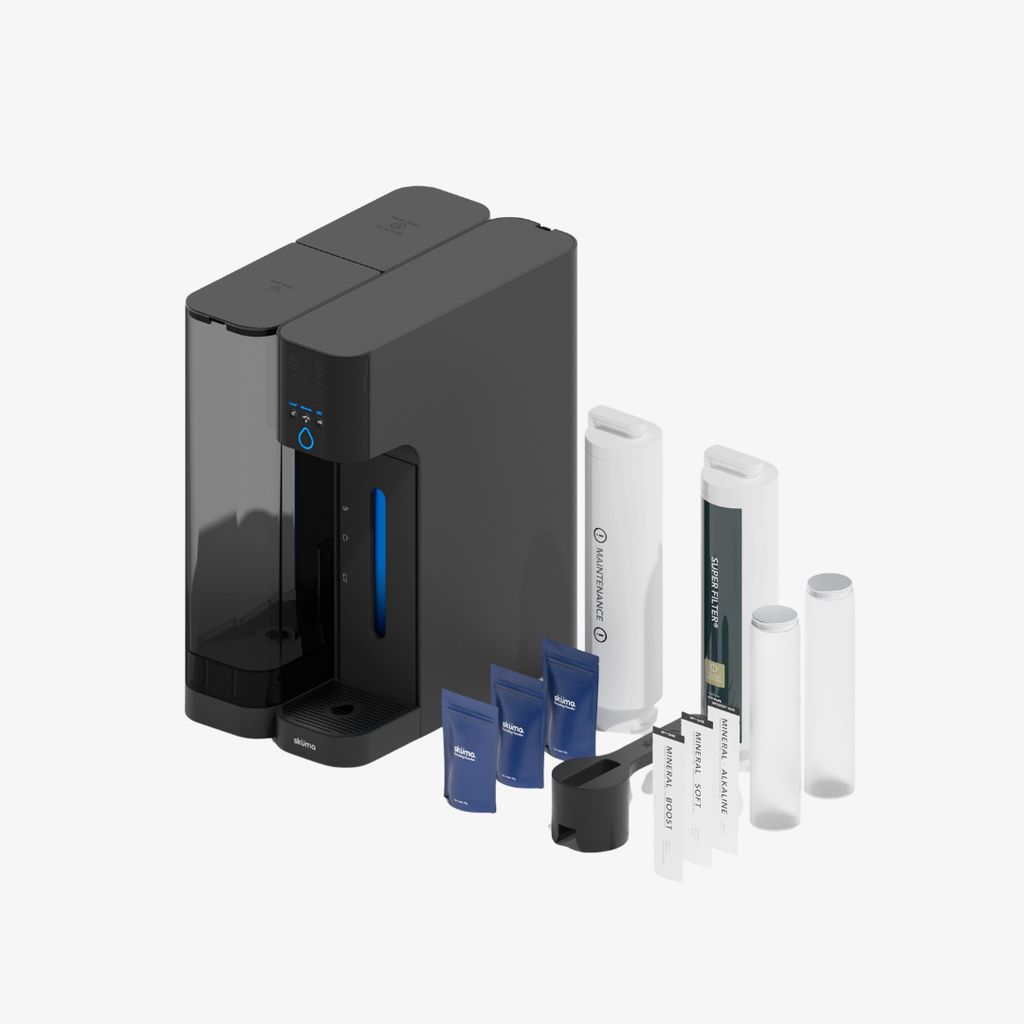
What the three-stage filter actually does

Stage one is a sediment pre-filter that removes particulates and protects the stages behind it. Stage two is a high-performance activated carbon block, which is the workhorse for chlorine, chlorination by-products, VOCs and taste. Stage three is a reverse-osmosis membrane, which is what allows the headline figures on PFAS, heavy metals, microplastics and dissolved solids. Reverse osmosis is the most demanding domestic filtration technology in common use, and it is also the reason a remineralisation step exists at all.

Why minerals are added back

Reverse osmosis is indiscriminate: it removes beneficial minerals along with contaminants, which is why RO water can taste flat. The MY™ Station addresses this by letting you dose a mineral profile back into the purified water. Treat this as a taste and preference feature rather than a nutritional intervention: the meaningful contribution of minerals in most diets comes from food, not water.

Running costs and consumables

The brand publishes a figure of roughly £0.04 per litre, which compares favourably with bottled water and with repeat-purchase jug cartridges over a year. The honest framing is that this is a total-cost figure including consumables, and it depends on you replacing the Super-Filter on schedule. A reverse-osmosis system that is overdue a filter change is not delivering the tested performance. Factor consumables into the decision, not just the upfront price.

Where it fits: and where it does not

This suits households on mains water who want measurable reduction across a broad contaminant list without plumbing work, and renters who cannot install an under-sink system. It is less suited to anyone who needs high continuous throughput, wants a plumbed-in whole-home solution, or is filtering private well or borehole water: that case needs a supply-specific test first, then a system matched to the result. Reverse osmosis also produces some reject water, which is worth knowing if water usage matters to you.

Specifications

Power
Mains electric
Install
None (countertop)
Material
Plastic housing
Filter life
About 12 months
Filter media
3-stage RO Super-Filter, mineral cartridges
How strong is the research? What our grades mean ›
Strong research
Independent certification or lab data for the specific claim.
Promising research
The material is well supported, but there is no product-level testing.
Early research
Little independent research.
Mixed research
Research findings disagree.
£
Under £20
££
£20 to £79
£££
£80+

Compare with similar

Feature
Sküma MY™ Station Countertop Reverse Osmosis, image 1
MY™ Station Countertop Reverse OsmosisThis product
Waterdrop M6SL Mineral Countertop Reverse Osmosis, image 1
M6SL Mineral Countertop Reverse Osmosis
AquaTru Under Sink Reverse Osmosis System, image 1
Under Sink Reverse Osmosis System
Waterdrop G3P600 Reverse Osmosis System, image 1
G3P600 Reverse Osmosis System
Price£359£329 typical£375£549.98 typical
MaterialPlastic housingPlastic housingPlastic housingPlastic housing
Filter media3-stage RO Super-Filter, mineral cartridgesComposite pre-filter, RO membrane, mineral post-filterPre-filter, carbon, RO membrane, VOC carbonSediment, carbon block, RO membrane, post-carbon
ResearchEarly researchPromising researchStrong researchStrong research
LinkYou're hereView ›View ›View ›

Quick questions

How were the Sküma Super-Filter performance results tested and certified?

Performance was evaluated and certified in February 2025 by an independent French laboratory accredited by COFRAC. More than 230 contaminants likely to be present in tap water were selected using reports from the French Regional Health Agencies (ARS) and NSF/ANSI standards. Test water was enriched with those contaminants before being filtered, so elimination rates could be measured precisely.

What contaminants does the Super-Filter reduce, and by how much?

The published results report elimination of 99.9% of water contaminants: including 165 pesticides and their metabolites, 20 PFAS, 14 heavy metals, pharmaceutical residues, volatile organic compounds, vinyl chloride monomers and perchlorates: plus 98% of microplastics, 96% of total dissolved solids and 61% of TFA (trifluoroacetic acid). In most cases post-filtration concentrations reached the limit of quantification of the analyses.

Is the MY™ Station NSF certified?

No. The testing protocol referenced NSF/ANSI standards when selecting contaminants, but the unit itself does not carry an NSF or WQA product certification mark. That is a meaningful distinction: NSF certification includes ongoing audit and re-testing, whereas a laboratory report is a point-in-time evaluation. The COFRAC-accredited testing is independent; it is not the same thing as a standing certification.

Does the MY™ Station require plumbing or installation?

No. It is a countertop unit that fills from its own tank and plugs in, so there is no under-sink work, no drilling and nothing to reinstate when you move. That is the main practical reason to choose it over a plumbed reverse-osmosis system.

Part of your longer life. Related guides and swaps.

Sources

  1. skumawater.com
  2. healf.com