Food & Kitchen
Reverse Osmosis Water Filters UK: Are They Worth It?
Quick answer
A reverse osmosis water filter pushes water through a very fine membrane, reducing lead, most PFAS, nitrate, fluoride and dissolved minerals. It is worth it if you want the broadest certified reduction and accept some waste water and lower mineral content. Look for NSF/ANSI 58 certification for the exact model.
Our picks


Waterdrop G3P600 Reverse Osmosis System
Waterdrop
- • IAPMO-certified to NSF/ANSI 42, 53 and 58
- • Certified for lead, PFOA/PFOS and TDS
Honest caveat: It needs mains power, a drain connection and a dedicated tap, so plan for a plumber. RO removes nearly all minerals; a remineralising cartridge is sold separately (about £34). Price was a £150 discount when checked.
Amazon · Waterdrop


AquaTru Under Sink Reverse Osmosis System
AquaTru
- • IAPMO-listed to NSF/ANSI 42, 53, 58 and 401
- • Certified for lead, PFOA/PFOS and microplastics
Honest caveat: The UK page itself only says ’tested according to NSF standards’; the detail comes from the IAPMO listings. AquaTru says about 3 litres of tap water make 1 litre of filtered water, and the manufacturer limit is 10 grains per gallon of hardness, which many English homes exceed unless the feed is softened.
AquaTru · Amazon


AquaTru Classic Countertop Reverse Osmosis
AquaTru
- • IAPMO-listed to NSF/ANSI 42, 53, 58 and 401
- • No plumbing, fill from your tap
Honest caveat: It was listed as sold out on AquaTru UK when we checked. It is large, plugs in, and you empty a waste tank by hand. The UK product page does not itself spell out the certifications.
Amazon · AquaTru
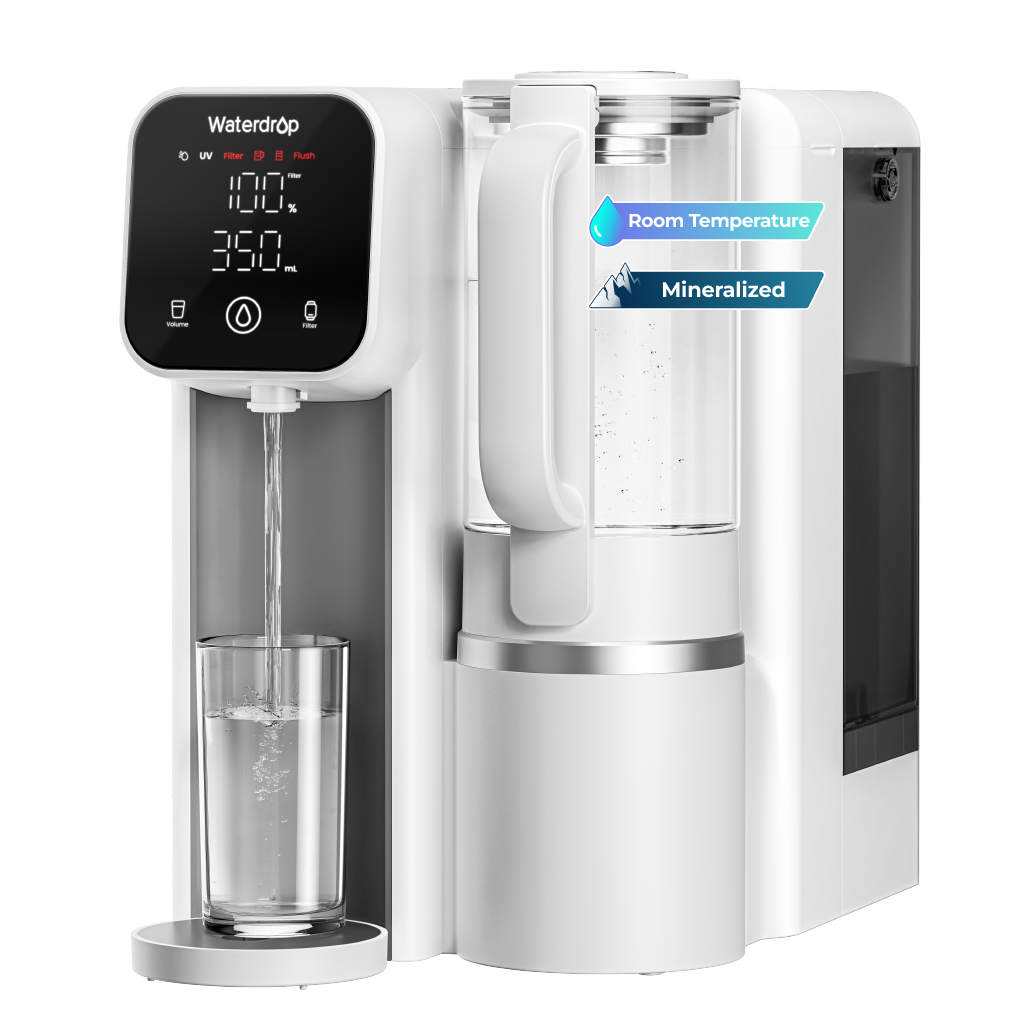

Waterdrop M6SL Mineral Countertop Reverse Osmosis
Waterdrop
- • Plug-in, no plumbing
- • 3:1 pure-to-drain ratio
Honest caveat: Waterdrop does not name the certifier or list which NSF/ANSI 58 claims (such as lead or PFOA/PFOS) apply to this model, and we did not find a listing for it. The mineral dose is small and is about taste, not nutrition.
Amazon · Waterdrop
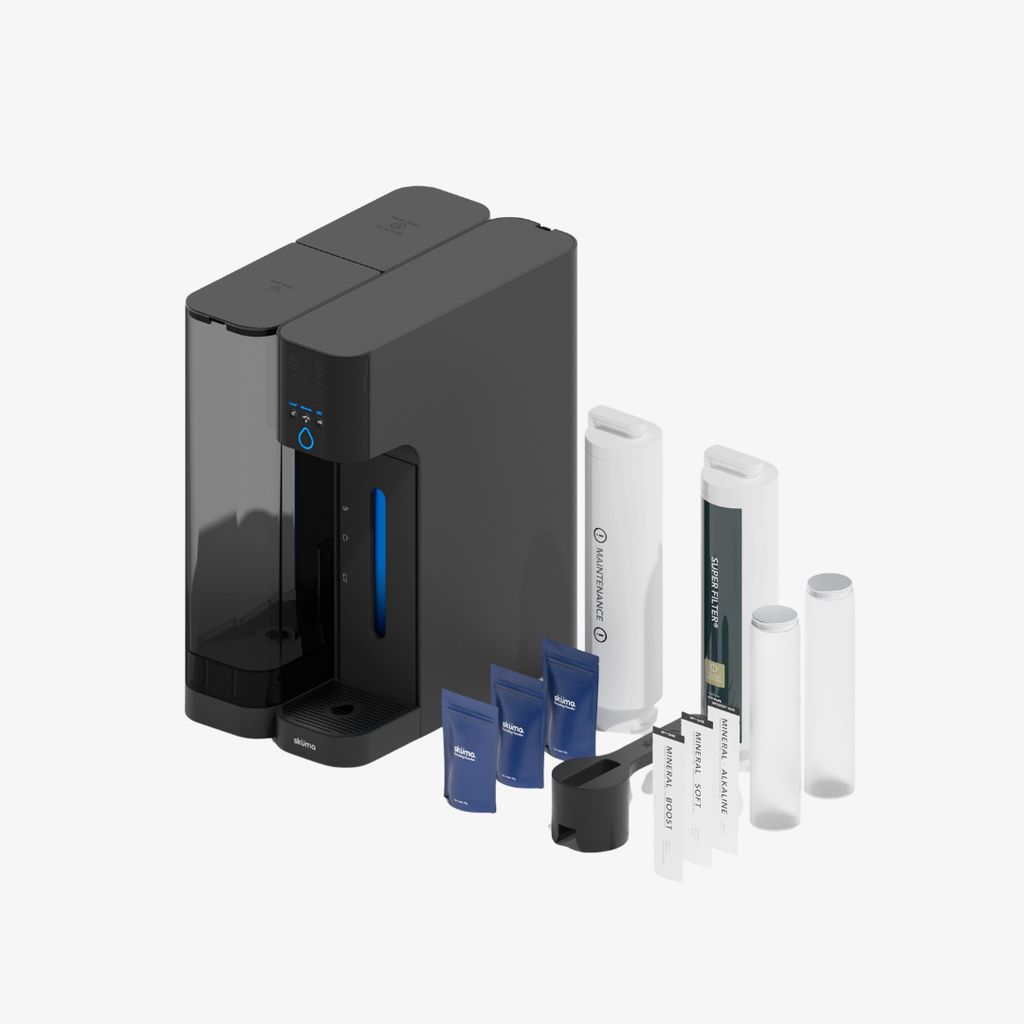

Sküma MY™ Station Countertop Reverse Osmosis
Sküma
- • Countertop RO with swappable mineral profiles
- • Brand claims 20 PFAS reduced, lab not named
Honest caveat: Sküma names no certifier, no NSF/ANSI 58 certification and no lab, and publishes no waste-water ratio. A Healf customer review says the waste tank fills quickly. Until test reports are public, we grade the evidence as limited.
Sküma · Amazon


AquaTru Carafe Countertop Reverse Osmosis
AquaTru
- • IAPMO-listed to NSF/ANSI 42, 53, 58 and 401
- • Glass carafe for the filtered water
Honest caveat: Sold out on AquaTru UK when checked. The certification match covers the AT100 model within the Carafe family, which we could not tie to one UK SKU with certainty.
AquaTru · Amazon
We may earn a commission if you buy through our links. How we choose ›
How strong is the research? What our grades mean ›
- Strong research
- Independent certification or lab data for the specific claim.
- Promising research
- The material is well supported, but there is no product-level testing.
- Early research
- Little independent research.
- Mixed research
- Research findings disagree.
- £
- Under £20
- ££
- £20 to £79
- £££
- £80+
What is a reverse osmosis water filter?
Reverse osmosis (RO) uses water pressure, sometimes boosted by a pump, to push water through a semi-permeable membrane with extremely small pores. Water molecules pass; most dissolved salts, metals and larger molecules are held back and flushed to a drain. A typical home system has three to five stages: a sediment pre-filter, a carbon pre-filter (to protect the membrane from chlorine), the RO membrane, then a carbon "polishing" filter and sometimes a remineralising stage.
Because it removes dissolved substances that carbon cannot, RO is the broadest type of home filter. In the Duke and NC State study of filters in real homes, under-sink RO systems removed nearly all of the PFAS ("forever chemicals") tested (Herkert et al. 2020).
Are reverse osmosis water filters worth it in the UK?
It depends on why you want one. UK tap water already meets tight legal standards (Which?). RO makes most sense if:
- your home predates 1970 and may have lead pipes (DWI), and you want a certified backstop while pipes are replaced;
- you want to lower PFAS exposure further than the DWI's precautionary 0.1 micrograms per litre guideline for 48 PFAS (DWI);
- you are on a private supply, or want lower nitrate, fluoride or dissolved solids.
If you mainly want better taste, a carbon jug or under-sink filter is cheaper and wastes no water.
Our picks at a glance
| Product | Best for | Material/key feature | Price | Evidence grade |
|---|---|---|---|---|
| Waterdrop G3P600 Reverse Osmosis System | Best under-sink RO | Tankless, 2:1, NSF/ANSI 42, 53, 58 | £549.98 | Strong |
| AquaTru Under Sink Reverse Osmosis System | Most certified claims | NSF/ANSI 42, 53, 58, 401 | £375 | Strong |
| AquaTru Classic Countertop Reverse Osmosis | Certified RO, no plumbing | Countertop, NSF/ANSI 42, 53, 58, 401 | £475 | Strong |
| Waterdrop M6SL Mineral Countertop Reverse Osmosis | Value countertop with minerals | 3:1, remineralising stage | £329 | Moderate |
| Sküma MY™ Station Countertop Reverse Osmosis | Choosing a mineral profile | Countertop RO plus mineral bases | £359 | Limited |
| AquaTru Carafe Countertop Reverse Osmosis | Serving from glass | Glass carafe, NSF/ANSI 42, 53, 58, 401 | £425 | Strong |
How we chose
We prioritised RO systems with a public NSF/ANSI 58 listing for the exact model. NSF/ANSI 58 is the standard for home RO: it tests TDS (total dissolved solids) reduction and named health claims such as lead, arsenic, fluoride and nitrate. PFOA/PFOS claims sit under NSF/ANSI 53 or 58, and NSF says a PFAS claim requires reduction to below 20 parts per trillion (NSF). Listings can come from NSF, IAPMO R&T or WQA. We verified UK prices and noted waste ratio, power, installation and hardness limits.
What should you check before buying an RO system?
Waste water ratio
All RO systems send some water to drain to carry away what the membrane rejects. Modern tankless units quote a "pure-to-drain" ratio of 2:1 or 3:1, meaning 1 litre to drain for every 2 or 3 litres you drink. AquaTru says about 3 litres of tap water make 1 litre of filtered water. The waste is ordinary tap water with more minerals; some people use it for cleaning or plants.
Remineralisation
RO removes most calcium and magnesium, which can make water taste flat. The WHO has reviewed the health considerations of long-term drinking of demineralised water and how it can be reconstituted (WHO). Most of your minerals come from food, but a remineralising post-filter improves taste and is a reasonable extra. Treat "alkaline" marketing as a taste preference, not a health benefit.
Hard water
England has some of the hardest water in Europe. Hardness can scale an RO membrane and shorten its life. AquaTru's stated limit is 10 grains per gallon (about 171 mg/L as calcium carbonate); above that it advises softening the feed. Check your water company's hardness figure before buying.
Countertop or under-sink?
Under-sink RO needs a plumber, a drain connection, usually a socket, and a separate tap, but is hidden and plumbed in. Countertop RO plugs in and you fill it by hand, which suits renters but takes worktop space and the waste tank needs emptying.
Can you fit reverse osmosis yourself?
Countertop units need no fitting at all. Under-sink systems involve tapping into the cold supply, drilling for a tap and connecting a drain saddle to the waste pipe. Confident DIYers manage it, but a mistake can mean leaks in a cupboard you rarely look in. A WaterSafe-accredited plumber, as the DWI suggests for work on drinking water pipes (DWI), is the lower-risk route and lets you add a leak detector at the same time.
Our picks in detail
Waterdrop G3P600 Reverse Osmosis System: best under-sink RO
IAPMO R&T certifies the G3P600 to NSF/ANSI 58 (including lead and TDS), 53 (including PFOA and PFOS) and 42 (TapWaterData). It is tankless, fills a glass quickly and sends only 1 litre to drain for every 2 filtered. Caveat: it needs a plumber, power and a dedicated tap, and remineralisation is a separate cartridge.
AquaTru Under Sink Reverse Osmosis System: most certified claims
The ATU200 is IAPMO-listed under NSF/ANSI 42, 53, 58 and 401, adding microplastics and some medicines to lead and PFOA/PFOS (TapWaterData). At £375 it is slightly cheaper than the Waterdrop. Caveat: about 3:1 tap-to-filtered water and a 10 grains per gallon hardness limit, which many English homes exceed.
AquaTru Classic Countertop Reverse Osmosis: best countertop
The most thoroughly certified countertop RO we found: IAPMO lists it under NSF/ANSI 42, 53, 58 and 401 (TapWaterData). No plumbing needed. Caveat: £475, bulky, and sold out on AquaTru UK when we checked.
Waterdrop M6SL Mineral Countertop Reverse Osmosis: best value countertop
A plug-in unit with a 3:1 ratio that adds minerals back for taste, at £269. Waterdrop states NSF/ANSI 58 and 372 certification. Caveat: Waterdrop does not name the certifier or which claims are covered, and we found no public listing, so we grade it moderate.
Sküma MY™ Station Countertop Reverse Osmosis: also consider
A compact countertop RO from a UK brand with swappable mineral profiles, popular with coffee lovers. Sküma claims reduction of 20 PFAS and validation by an independent French lab. Caveat: no certifier, certification or lab is named and no waste ratio is published, so the evidence is limited.
AquaTru Carafe Countertop Reverse Osmosis: also consider
IAPMO lists the AT100 model in this family under NSF/ANSI 42, 53, 58 and 401, and filtered water goes into a glass carafe (TapWaterData). Caveat: sold out on AquaTru UK when checked.
What the evidence says
- RO is the broadest home option. Under-sink RO and two-stage systems removed nearly all PFAS in real homes, unlike most jugs (Herkert et al. 2020).
- Certification is per claim. Look for NSF/ANSI 58 plus the specific contaminant you care about (NSF).
- Even good RO is not 100%. Belgian consumer group Test-Achats notes RO removes nearly all PFAS but also strips minerals, wastes water and costs more (Test-Achats).
- Maintenance matters. Pre-filters protect the membrane; skipping changes shortens its life and can lower performance.
What to avoid
- "RO" units with no NSF/ANSI 58 listing for the exact model.
- Old-style tank systems with no stated ratio; some waste several litres per litre.
- Fitting RO to softened water without checking the sodium; the DWI advises an unsoftened drinking tap (DWI).
- Paying extra for "alkaline" or "hydrogen" claims; these are taste features.
Bottom line
A certified RO system is the most thorough way to lower lead, PFAS and dissolved solids at home. If you own your home, the Waterdrop G3P600 balances certification, speed and low waste; the AquaTru Under Sink covers more listed claims. If you rent, the AquaTru Classic is the best-certified countertop when in stock, with the Waterdrop M6SL as a cheaper option. If you only want better taste, skip RO and see our best water filter guide.
Frequently asked questions
Does reverse osmosis remove PFAS?
+
Yes, largely. In a Duke University study of home filters, under-sink RO systems removed nearly all of the PFAS tested. Certified systems list PFOA and PFOS under NSF/ANSI 53 or 58, and NSF requires reduction to below 20 parts per trillion for a PFAS claim. Performance depends on maintenance and the specific PFAS present.
Is reverse osmosis water bad for you because it has no minerals?
+
Most of the minerals you need come from food, not water. The WHO has reviewed long-term drinking of demineralised water and how to add minerals back, and many RO systems include a remineralising stage for taste. If you have a medical condition or restricted diet, ask your GP. For most people this is mainly about taste.
How much water does reverse osmosis waste?
+
Modern tankless systems send about 1 litre to drain for every 2 or 3 litres of filtered water. The Waterdrop G3P600 quotes 2:1, the Waterdrop M6SL 3:1, and AquaTru says about 3 litres in gives 1 litre out. Older tank systems could be far less efficient.
What does NSF/ANSI 58 mean?
+
NSF/ANSI 58 is the standard for home reverse osmosis systems. An accredited body tests reduction of TDS (total dissolved solids) and lists specific health claims, such as lead, arsenic, fluoride or nitrate, for each certified model. Certification can be issued by NSF, IAPMO R&T or WQA. Always check which claims are listed for your exact model.
Will reverse osmosis work with hard water?
+
Yes, but hardness can scale the membrane and shorten its life. Some manufacturers set limits; AquaTru, for example, states 10 grains per gallon, roughly 171 mg/L as calcium carbonate. Much of England is harder than that. Check your water company's hardness data and the unit's limit, or soften the feed while keeping a separate unsoftened drinking supply.
Is countertop or under-sink reverse osmosis better?
+
Under-sink RO is hidden and plumbed in but needs a plumber, a drain connection, a separate tap and usually power. Countertop RO plugs in with no plumbing, which suits renters, but takes worktop space and you empty the waste tank by hand. Both can be NSF/ANSI 58 certified.
Last updated