Food & Kitchen
PFAS Water Filter UK: What Actually Removes Forever Chemicals
Quick answer
The filters with the strongest evidence for reducing PFAS are reverse osmosis systems certified to NSF/ANSI 58 and carbon or ion-exchange filters certified to NSF/ANSI 53 for PFOA and PFOS. In the UK, the ZeroWater jug is the cheapest certified option. BRITA MAXTRA PRO reduces some PFAS in independent tests but is not certified.
Our picks
ZeroWater 5-Stage Water Filter Jug
ZeroWater (Culligan)
- • IAPMO-certified to NSF/ANSI 53 for lead, PFOA and PFOS
- • Top performer for total PFAS in a 2024 independent jug study
Honest caveat: The ion-exchange resin also strips calcium and magnesium, so in hard UK water the cartridge can be used up in a few weeks and running costs climb. The 2024 study saw the filter release dissolved solids and drop pH once spent in one water type. Its TDS (total dissolved solids) removal claim is not certified.
ZeroWater (Culligan)


Waterdrop G3P600 Reverse Osmosis System
Waterdrop
- • IAPMO-certified to NSF/ANSI 42, 53 and 58
- • Certified for lead, PFOA/PFOS and TDS
Honest caveat: It needs mains power, a drain connection and a dedicated tap, so plan for a plumber. RO removes nearly all minerals; a remineralising cartridge is sold separately (about £34). Price was a £150 discount when checked.
Waterdrop


AquaTru Under Sink Reverse Osmosis System
AquaTru
- • IAPMO-listed to NSF/ANSI 42, 53, 58 and 401
- • Certified for lead, PFOA/PFOS and microplastics
Honest caveat: The UK page itself only says ’tested according to NSF standards’; the detail comes from the IAPMO listings. AquaTru says about 3 litres of tap water make 1 litre of filtered water, and the manufacturer limit is 10 grains per gallon of hardness, which many English homes exceed unless the feed is softened.
AquaTru


AquaTru Classic Countertop Reverse Osmosis
AquaTru
- • IAPMO-listed to NSF/ANSI 42, 53, 58 and 401
- • No plumbing, fill from your tap
Honest caveat: It was listed as sold out on AquaTru UK when we checked. It is large, plugs in, and you empty a waste tank by hand. The UK product page does not itself spell out the certifications.
AquaTru
BRITA Marella Jug with MAXTRA PRO
BRITA
- • Cheapest way into a carbon plus ion-exchange jug
- • Tested by Test-Achats for PFAS with good results
Honest caveat: This is one consumer-group test, not a certification. BRITA does not publish lead percentages and the cartridge lasts only about 150 litres. The DWI notes ion-exchange jugs reduce temporary hardness only, not all hardness.
BRITA
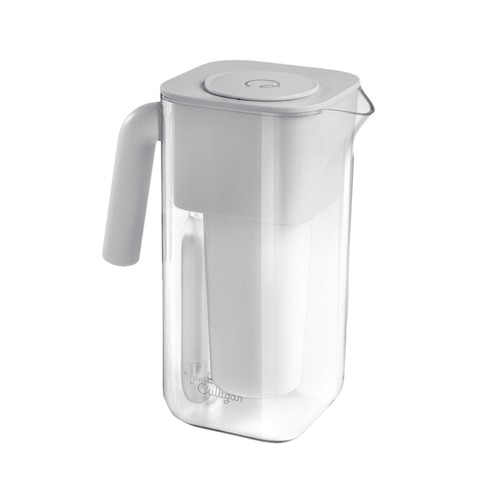
ZeroWater 1.7L Jug with TDS Meter
ZeroWater (Culligan)
- • Same certified cartridge type as the 2.8L ZeroWater jug
- • Comes with a TDS meter
Honest caveat: 1.7 litres means frequent refills. As with all ZeroWater jugs, hard water uses up the resin quickly, and the filtered water is very low in minerals, which some people find tastes flat.
ZeroWater (Culligan)
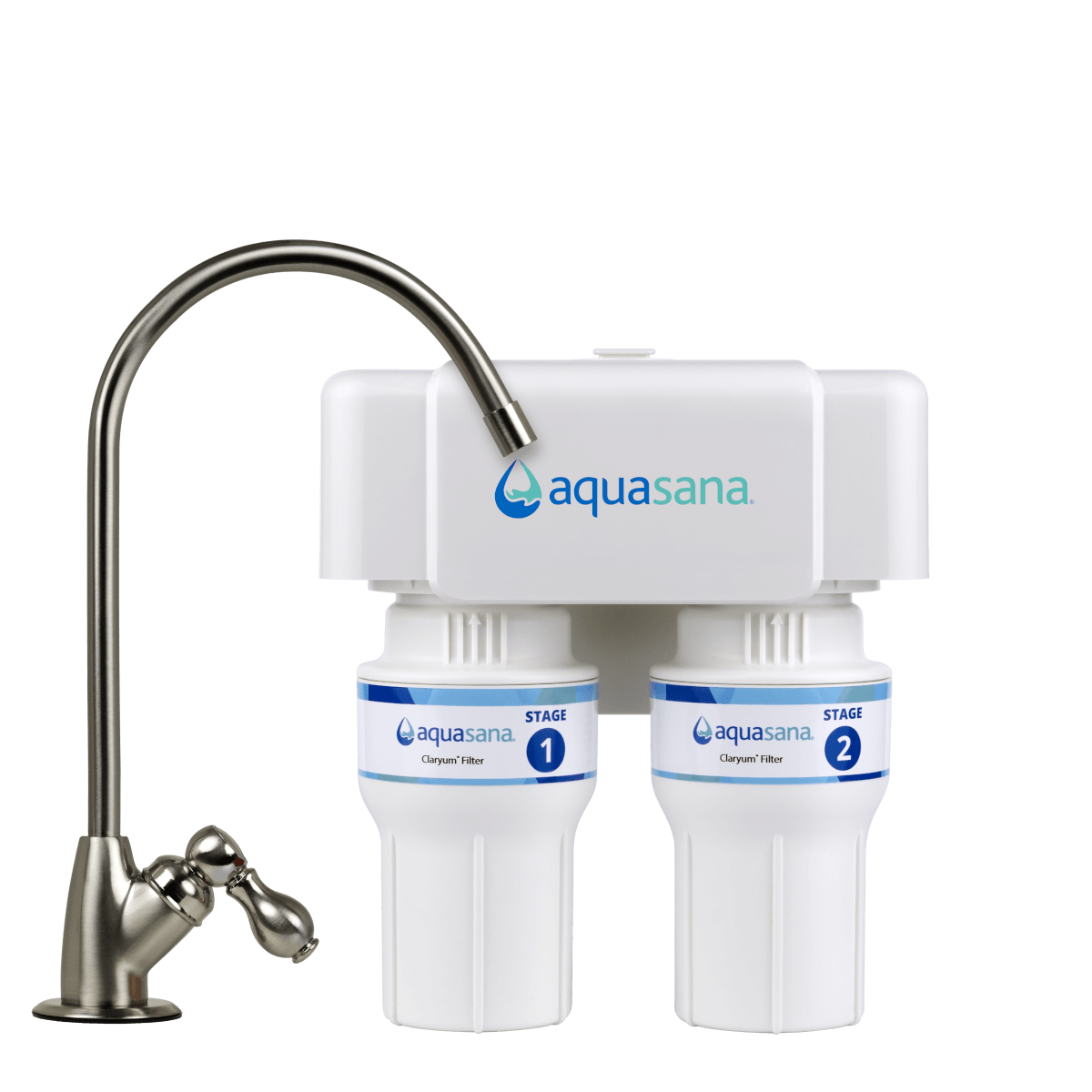
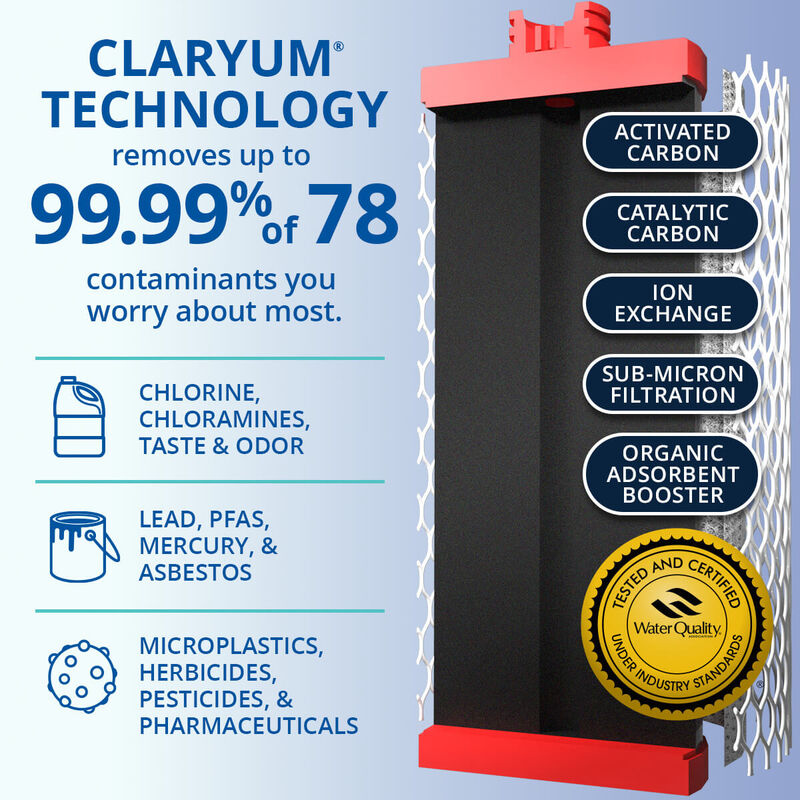
Claryum 2-Stage Under Sink Water Filter
Aquasana
- • WQA certified to NSF/ANSI 42, 53 and 401
- • Certified for lead, PFOA/PFOS and microplastics
Honest caveat: We could not find a UK retailer or UK Aquasana store, so you would be importing a US product (US$249.99) with US plumbing fittings. Listings we saw were for the AQ-5200 model; the newer AQ-6200 has its own entries. Chloramine reduction is certified only as an aesthetic (taste) claim.
Aquasana
We may earn a commission if you buy through our links. How we choose ›
How strong is the research? What our grades mean ›
- Strong research
- Independent certification or lab data for the specific claim.
- Promising research
- The material is well supported, but there is no product-level testing.
- Early research
- Little independent research.
- Mixed research
- Research findings disagree.
- £
- Under £20
- ££
- £20 to £79
- £££
- £80+
Is there PFAS in UK tap water?
PFAS (per- and polyfluoroalkyl substances, often called "forever chemicals") are detected at low levels in some UK water sources. There is no legal PFAS limit for drinking water in England and Wales yet. Instead, the Drinking Water Inspectorate (DWI) uses precautionary guidance, updated in March 2025, with a guideline of 0.1 micrograms per litre for the sum of 48 named PFAS. Water companies must monitor, assess risk and add treatment or remove a source from supply if needed (DWI).
Monitoring is extensive. In 2025 the industry ran more than 666,000 PFAS analyses across England and Wales; in Wales, none of 30,000 tests reached 0.1 micrograms per litre (DWI annual report). The government's PFAS Plan, published in February 2026, commits to consulting on a statutory PFAS limit for drinking water (GOV.UK). EFSA lists drinking water as one of several dietary sources of PFAS, alongside fish, fruit and eggs (EFSA).
So for most UK homes a PFAS filter is a personal choice to lower exposure further, not a response to a known exceedance. For background, see what PFAS are.
Our picks at a glance
| Product | Best for | Material/key feature | Price | Evidence grade |
|---|---|---|---|---|
| ZeroWater 5-Stage Water Filter Jug | Certified PFOA/PFOS reduction on a budget | Ion-exchange jug, IAPMO-certified NSF/ANSI 53 | £45 | Strong |
| Waterdrop G3P600 Reverse Osmosis System | Broadest reduction under the sink | RO, NSF/ANSI 53 and 58 | £549.98 | Strong |
| AquaTru Under Sink Reverse Osmosis System | Most listed claims | RO, NSF/ANSI 42, 53, 58, 401 | £375 | Strong |
| AquaTru Classic Countertop Reverse Osmosis | No-plumbing RO | Countertop RO | £475 | Strong |
| BRITA Marella Jug with MAXTRA PRO | Partial reduction, lowest cost | Carbon plus ion-exchange | £29.99 | Moderate |
| ZeroWater 1.7L Jug with TDS Meter | Small households | Same certified cartridge | £30 | Strong |
| Claryum 2-Stage Under Sink Water Filter | Non-RO certified (US import) | WQA NSF/ANSI 53 PFOA/PFOS | US import | Strong |
How we chose
A credible PFAS filter should be certified to NSF/ANSI 53 or 58 with PFOA and PFOS listed for the exact model. NSF says a PFAS claim requires reduction to below 20 parts per trillion (NSF). The older NSF protocol P473 covered the same two PFAS and has been folded into these standards. Certification can be issued by NSF, IAPMO R&T or WQA. We then looked for independent studies covering a wider range of PFAS, because certification only tests PFOA and PFOS while the DWI monitors 48.
Which filter types remove PFAS?
The most useful real-world study is the 2020 Duke University and NC State work, which tested 89 filters in homes. Under-sink reverse osmosis and two-stage filters removed nearly all of the PFAS tested. Other activated carbon filters (jugs, tap-mount, fridge) were inconsistent, removing roughly 60 to 70% of long-chain PFAS and about 40% of short-chain PFAS. In four of eight whole-house carbon systems, PFAS levels went up (Herkert et al. 2020).
A 2024 lab and home study of five jug filters against 75 PFAS found big differences between brands: ZeroWater removed about 99 to 100% of total PFAS, while Brita Elite removed 20 to 48% depending on the water (Frontiers in Environmental Chemistry).
| Filter type | Typical PFAS performance | Notes |
|---|---|---|
| Reverse osmosis (NSF/ANSI 58) | Near-complete | Waste water, removes minerals |
| Two-stage under-sink carbon (NSF/ANSI 53) | Near-complete for tested PFAS | Keeps minerals |
| Ion-exchange jug (certified) | High for PFOA/PFOS; varies by brand | Short cartridge life in hard water |
| Basic carbon jug or tap filter | Variable, weaker on short-chain PFAS | Change cartridges on time |
| Whole-house carbon | Unpredictable | Some increased PFAS |
| Boiling | None | Does not reduce PFAS (NSF) |
Does BRITA remove PFAS?
Partly, and it depends on the cartridge. BRITA's UK page says MAXTRA PRO is "independently tested to reduce PFAS" such as PFOS and PFOA, using JWPAS and NSF/ANSI 53 test methods, but gives no percentages and the cartridge is not certified (BRITA). Belgian consumer group Test-Achats tested a Marella jug with MAXTRA+/MAXTRA PRO and found it removed up to 96% of some PFAS, all four PFAS that EFSA regulates, and 88% of TFA (a very short-chain PFAS) (Test-Achats). However, in the 2024 Canadian study a different BRITA cartridge (Elite) removed far less (Frontiers). Our view: BRITA MAXTRA PRO likely reduces PFAS meaningfully, but if PFAS is your main concern, choose a product certified for PFOA/PFOS.
Our picks in detail
ZeroWater 5-Stage Water Filter Jug: best value PFAS filter
IAPMO R&T certifies the cartridge to NSF/ANSI 53 for PFOA, PFOS, lead, mercury and hexavalent chromium (TapWaterData), and it topped the 2024 jug study for total PFAS. Caveat: in hard water the resin is used up quickly, and the study saw it release dissolved solids once spent in one water type, so change it when the meter says so.
Waterdrop G3P600 Reverse Osmosis System: best under-sink PFAS filter
IAPMO-certified to NSF/ANSI 53 for PFOA/PFOS and 58 for lead and TDS (TapWaterData), with a 2:1 pure-to-drain ratio. Caveat: needs a plumber, a socket and a drain, and removes minerals.
AquaTru Under Sink Reverse Osmosis System: most certified claims
IAPMO-listed under NSF/ANSI 53 (PFOA, PFOS), 58 and 401 (TapWaterData). Caveat: about 3:1 tap-to-filtered water, and a 10 grains per gallon hardness limit.
AquaTru Classic Countertop Reverse Osmosis: best no-plumbing PFAS filter
IAPMO-listed under NSF/ANSI 42, 53, 58 and 401 (TapWaterData). Caveat: £475 and sold out on AquaTru UK when we checked.
BRITA Marella Jug with MAXTRA PRO: budget partial option
At £29.99 it is the cheapest jug with independent consumer-test data showing substantial PFAS reduction (Test-Achats). Caveat: not certified, and results vary by BRITA cartridge.
ZeroWater 1.7L Jug with TDS Meter: small-household option
Same certified cartridge family in a fridge-door size. Caveat: small capacity.
Claryum 2-Stage Under Sink Water Filter: certified non-RO, US import
WQA-certified to NSF/ANSI 53 for PFOA/PFOS and lead, keeping minerals and wasting no water (TapWaterData). Caveat: no UK retailer we could verify.
How often should you change a PFAS filter?
Follow the maker's schedule, and shorten it if your water is hard or you use a lot. PFAS removal is not constant over a cartridge's life: as carbon or resin fills up, short-chain PFAS tend to break through first. The Duke study warned that poorly maintained filters can make PFAS levels worse (Herkert et al. 2020), and the 2024 jug study saw a spent ZeroWater cartridge release dissolved solids in one water type (Frontiers). France's food safety agency also advises keeping jugs in the fridge, drinking filtered water within about 24 hours and replacing cartridges on time (ANSES). For RO, change pre-filters on schedule to protect the membrane.
What the evidence says
- Certification covers PFOA and PFOS only. Independent studies suggest RO and good two-stage filters also cut many other PFAS, but short-chain PFAS are harder for carbon (Herkert et al. 2020).
- No filter is a reason to ignore your supplier's notices. The DWI requires water companies to tell customers about any risk and provide alternative water (DWI).
- Food is a major PFAS source too (EFSA), so a filter lowers one route of exposure, not all.
What to avoid
- "Removes PFAS" claims without NSF/ANSI 53 or 58 listing PFOA and PFOS for the exact model.
- Whole-house carbon systems for PFAS at the drinking tap.
- Overdue cartridges, which can release trapped PFAS.
- Boiling water to "remove" PFAS.
Bottom line
For most UK homes, PFAS levels in tap water are below the DWI guideline, so a filter is an optional extra layer. If you want one, a certified ion-exchange jug such as ZeroWater is the cheapest credible option, and an NSF/ANSI 58 reverse osmosis system such as the Waterdrop G3P600 or AquaTru is the most thorough. BRITA MAXTRA PRO reduces some PFAS but is not certified. See our under-sink guide and reverse osmosis guide.
Frequently asked questions
Does BRITA remove PFAS?
+
BRITA says MAXTRA PRO is independently tested to reduce PFAS such as PFOA and PFOS, and Belgian consumer group Test-Achats found it removed up to 96% of some PFAS. It is not certified for PFAS, and a different BRITA cartridge performed much worse in a 2024 study. If PFAS is your main concern, pick a filter certified to NSF/ANSI 53 or 58 for PFOA and PFOS.
Is there PFAS in UK tap water?
+
Low levels are detected in some sources. The DWI uses a precautionary guideline of 0.1 micrograms per litre for the sum of 48 PFAS and requires water companies to act above it. In 2025, none of 30,000 tests in Wales reached that level. The government is consulting on a legal PFAS limit for drinking water.
Does boiling water remove PFAS?
+
No. PFAS are extremely stable and boiling does not break them down. NSF specifically advises people not to boil water as a PFAS measure. Follow your water supplier's advice, and if you want an extra layer, use a filter certified for PFAS reduction instead.
What certification should a PFAS water filter have?
+
Look for NSF/ANSI 53 or NSF/ANSI 58 with PFOA and PFOS listed for the exact model. The certifier can be NSF, IAPMO R&T or WQA. NSF requires PFAS to be reduced to below 20 parts per trillion for a certified claim. Older listings may mention NSF P473, which covered the same two PFAS.
Does reverse osmosis remove all PFAS?
+
It removes most. In a Duke University study of home filters, under-sink RO removed nearly all of the PFAS tested. No filter is perfect, and performance falls if pre-filters and membranes are not changed on time. RO also removes minerals and sends some water to drain.
Do whole-house filters remove PFAS?
+
Not reliably. In the Duke study, whole-house carbon systems gave inconsistent results, and in four of eight homes PFAS levels in filtered water were higher than in tap water. A certified point-of-use filter at the drinking tap is the better choice for PFAS.
Last updated